
When you need to replace missing teeth, understanding your implant options can help you make the best choice for your smile.
All-on-4 uses just four implants to support a full arch of teeth, while traditional implants replace each tooth individually with one implant per tooth.
This basic difference affects everything from treatment time to cost to how your new teeth will function.
Both options can restore your ability to eat, speak, and smile confidently. Traditional implants work well if you’re missing just a few teeth and have healthy jawbone in those areas.
All-on-4 is designed for people who need to replace most or all teeth in an arch and want a faster solution that often avoids bone grafting.
Choosing between All-on-4 and traditional implants depends on your specific situation, including your bone health, budget, and timeline.
Learning how each option works will help you have a more informed conversation with your dentist about which treatment fits your needs.
Key Takeaways
- All-on-4 offers faster treatment with temporary teeth available the same day as surgery
- Traditional implants provide individual support for each missing tooth but require longer healing time
- Your jawbone health and the number of teeth you need replaced determine which option works best for you
What Are All-on-4 and Traditional Dental Implants?
Both approaches use titanium posts that fuse with your jawbone, but they differ significantly in how many implants you need and how they support your replacement teeth.
Defining All-on-4 Dental Implants
All-on-4 implants are a full-arch restoration technique that replaces an entire row of teeth using just four strategically placed implants. Two implants are positioned vertically in the front of your jaw, while two are angled toward the back.
This angled placement lets your dentist take advantage of the strongest areas of your jawbone without needing extra procedures.
The system supports a complete set of prosthetic teeth attached to a single framework. You can often receive temporary teeth on the same day as your surgery, which means you won’t leave the office without teeth.
This approach works well if you’re missing most or all of your teeth on one arch and want a faster solution than placing individual implants for each tooth.
Understanding Traditional Dental Implants
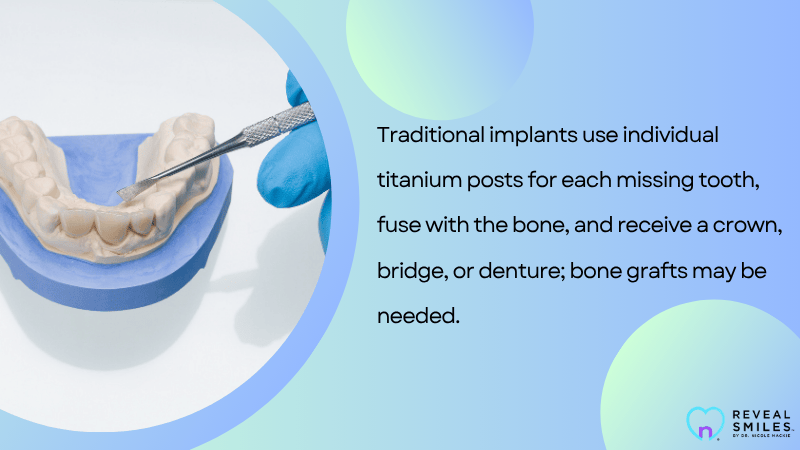
Traditional dental implants involve placing individual titanium posts into your jawbone, typically one implant for each missing tooth.
Your dentist surgically inserts each post where a natural tooth root would be. The implant then needs several months to fuse with your bone through a process called osseointegration.
After healing, your dentist attaches a small connector called an abutment to each implant. Finally, they place a custom crown, bridge, or denture on top.
Traditional implants work for single tooth replacement or replacing several teeth throughout your mouth. This method requires adequate bone density at each implant site, which sometimes means you’ll need bone grafting before the implants can be placed.
How the Procedures Work: Placement and Process
The two methods differ significantly in how implants are placed and how long you’ll wait for your final teeth. All-on-4 uses just four implants with an angled placement technique, while traditional implants require individual posts for each tooth replacement.
All-on-4 Procedure Steps
Your dentist will place four titanium implants into your jawbone during a single surgery. Two implants go straight into the front of your jaw where bone is typically stronger.
The back two implants are placed at an angle of up to 45 degrees to avoid areas with less bone density.
This angled placement is what makes the All-on-4 procedure unique. It lets your dentist work around areas where bone loss has occurred without needing bone grafts first.
You’ll receive temporary teeth on the same day as your implant surgery. These teeth are fully functional, so you can eat soft foods right away.
After osseointegration occurs over several months, your dentist will replace the temporary prosthesis with permanent replacement teeth.
The entire all-on-4 procedure typically takes 2-3 hours for one arch. You’ll need fewer follow-up appointments compared to traditional methods.
Traditional Implant Procedure Steps
Your dental implant procedure starts with placing individual titanium posts into your jawbone. Each post acts as an artificial tooth root. The number of implants depends on how many teeth you’re replacing.
After implant placement, you’ll wait 3-6 months for osseointegration to complete. This is when your bone fuses with the implant to create a stable foundation. You cannot receive your permanent teeth during this healing period.
Your dentist may provide you with a temporary denture or bridge while you heal. Once osseointegration is complete, you’ll return for an abutment placement. This small connector piece attaches to the implant and holds your replacement tooth.
Traditional implants require multiple surgeries spread over several months. If you need bone grafting due to bone loss, this adds 3-6 months to your treatment timeline before implants can even be placed.
Talk with an implant expert and get a personalized treatment recommendation.
Comparing Treatment Time and Recovery
All-on-4 dental implants offer significantly faster treatment compared to traditional implants, with most patients receiving temporary teeth on the same day.
Traditional implants require multiple appointments spread over several months to complete the full mouth restoration process.
Procedure Timeline Differences
The All-on-4 procedure can be completed in a single day, allowing you to walk out with a fixed temporary prosthetic attached to just four implants per arch.
Your dentist will extract any damaged teeth, place the implants, and attach your temporary full-arch replacement during one appointment. You’ll return later to have your permanent tooth replacement installed once healing is complete.
Traditional implants follow a much longer timeline. Each implant needs to be placed individually, which means one implant for every missing tooth you need replaced.
After placement, you must wait three to six months for osseointegration before receiving your permanent crowns or bridges. Traditional implants may take up to 12 months with multiple surgeries if you need bone grafting procedures to build up your jawbone density.
Healing and Recovery for Each Option
All-on-4 recovery typically takes one to three days, with most patients returning to normal activities quickly. You’ll experience some swelling and discomfort initially, but the less invasive nature of the surgery means faster healing time overall.
The angled placement of the posterior implants reduces trauma to your surrounding tissues.
Traditional implants require longer healing between each surgical stage. You’ll need to wait for complete osseointegration at each implant site before moving forward.
If bone grafting is necessary for your full-arch restoration, you’ll face additional healing time of several months before implant placement can even begin. Each individual surgery site needs proper recovery time.
Bone and Gum Requirements
Your jawbone health and bone density play a major role in determining which implant option works best for you. All-on-4 implants typically need less bone volume than traditional implants, which can affect whether you need additional procedures before treatment.
Bone Density and Bone Grafting
Traditional implants require adequate bone density at each implant site. If you don’t have enough healthy jawbone, your dentist will likely recommend a bone graft before placing the implants. This adds extra time and cost to your treatment.
A bone graft involves adding bone material to strengthen your jaw. You’ll need to wait several months for the graft to heal before getting your implants. This extends your total treatment time significantly.
All-on-4 implants work differently. The four implants are strategically angled to avoid areas with low bone density. The back implants are placed at a 45-degree angle to use the strongest parts of your jawbone. This means you can usually skip bone grafting entirely.
Suitability for Severe Bone Loss
If you’re dealing with severe bone loss, All-on-4 implants offer a clear advantage. The angled placement technique lets your dentist work around areas where your jawbone has deteriorated.
You can move forward with treatment even if you’ve been told you don’t have enough bone for traditional implants.
Traditional implants become challenging when you have significant bone loss. You would need multiple bone grafts to build up enough support for each individual implant. This can mean multiple surgeries over many months.
Your gum health matters too. Both options require healthy gums for success, but All-on-4’s reduced number of implant sites means less overall surgical impact on your gum tissue.
Cost, Maintenance, and Long-Term Considerations
When you compare All-on-4 and traditional dental implants, you’ll notice differences in upfront costs, maintenance needs, and how long your results last. Your choice affects both your budget today and your oral health for years to come.

Cost Comparison
All-on-4 often costs less upfront when you need to replace missing teeth across an entire arch. You only need four implants instead of six to eight per arch with traditional methods.
The lower number of implants means fewer surgical procedures and less time in the dentist’s chair. You also save money if you can avoid bone grafting, which All-on-4 typically doesn’t require.
Traditional dental implants may be more budget-friendly if you’re only replacing one or two teeth. Each implant gets its own crown, which works well for individual gaps in your smile.
Keep in mind that your prosthetic teeth attached to All-on-4 implants may need replacement after 10-15 years due to normal wear. The implants themselves are designed to be permanent, but the fixed prosthesis on top experiences daily use.
Long-Term Success and Care
Both dental restoration options have excellent track records when you maintain proper oral hygiene. Studies show dental implants can achieve a 98% success rate with good care.
Your daily routine stays similar regardless of which option you choose. You need to brush twice daily, floss carefully around your implants, and visit your dentist regularly.
Daily care requirements:
- Brush with a soft-bristled toothbrush
- Use specialized floss or water flossers
- Avoid hard foods that could damage prosthetic teeth
- Schedule professional cleanings every six months
All-on-4 provides a fixed prosthesis that feels more stable than removable dentures. Traditional implants also stay permanently in place, giving you confidence when eating and speaking.
Your gums and surrounding bone need to stay healthy to support either type of implant long-term. Regular checkups help catch any issues early before they affect your oral health.
Choosing the Right Option for Your Needs
Your best choice depends on how many teeth you’re missing and the condition of your jawbone. If you need a full arch of teeth replaced and want faster results, All-on-4 might fit your situation better, while single-tooth gaps often work best with traditional implants.
Who Should Consider All-on-4?
You’re a good fit for All-on-4 if you’re missing most or all teeth in your upper or lower jaw. This option works well when you want to avoid bone grafting or don’t have enough bone density for multiple individual implants.
All-on-4 makes sense if you’re looking for a faster treatment timeline. You can often walk out with temporary teeth on the same day as your surgery, which means less time away from work and normal activities.
You should consider All-on-4 implants if cost is a major factor. Since only four implants support an entire arch of teeth, you’ll spend less than placing eight or more individual posts. This approach also means fewer surgical sites and typically shorter recovery periods.
Who Should Consider Traditional Implants?
Traditional implants are your better choice when you’re only missing one, two, or a few scattered teeth. Single-tooth implants give you individual replacement for each gap, which preserves more of your natural tooth structure.
You’re a good candidate for traditional implants if you have healthy jawbone density and gums. When comparing all-on-4 vs traditional implants, traditional options work better if you don’t mind a longer treatment process spread over several months.
Choose traditional implants when you want the most customized result possible. Each crown gets designed to match your neighboring teeth perfectly.
You’ll also find traditional implants ideal if you prefer replacing teeth gradually over time rather than committing to full-arch restoration all at once.
Frequently Asked Questions
The number of implants needed, treatment timelines, and costs vary significantly between these two approaches. Understanding bone grafting requirements and recovery periods helps patients make informed decisions about their dental restoration.
What are the main differences between All-on-4 and traditional dental implants?
The main difference lies in the number of implants needed for each approach. All-on-4 uses just four implants per arch to support a full set of teeth, while traditional implants typically require one implant for each missing tooth.
Traditional implants involve multiple surgeries with longer healing periods between procedures. All-on-4 often allows you to receive temporary teeth on the same day as your surgery.
The placement technique also differs between the two options. All-on-4 uses two implants placed vertically in the front of your jaw and two angled implants in the back.
Traditional implants are placed individually and straight into the jawbone where each tooth is missing.
What are the cost comparisons for All-on-4 implants versus single dental implants?
All-on-4 is often more cost-effective for full-arch replacement, while traditional implants may be more budget-friendly if you only need to replace one or two teeth.
The initial investment for All-on-4 may seem higher, but the overall cost is often lower when you need to replace all your teeth.
Traditional implants can become expensive when multiple teeth need replacement. Each implant requires its own surgical procedure, healing time, and individual crown.
The reduced number of surgeries and shorter treatment timeline with All-on-4 also means fewer dental visits. This can save you money on travel expenses and time off work.
How does the success rate of All-on-4 implants compare to individual dental implants?
Both All-on-4 and traditional dental implants offer high success rates when properly cared for. The long-term success of either option depends on factors like your bone health, oral hygiene habits, and following your dentist’s care instructions.
Traditional implants have a longer track record in dentistry. They’ve been used successfully for decades to replace missing teeth.
All-on-4 is a newer technique but has shown excellent results in clinical studies. The angled placement of the back implants helps maximize bone support and stability.
Your individual success rate will depend on your specific oral health condition. Factors like smoking, diabetes, and gum disease can affect how well your implants integrate with your jawbone.
Are there any specific advantages of choosing All-on-4 implants over conventional implant options?
All-on-4 often eliminates the need for bone grafting procedures. The angled placement of the implants allows your dentist to use the bone you have available, even if you’ve experienced some bone loss.
You can often leave the dental office with temporary teeth on the same day as your surgery. This means you won’t have to spend months without teeth while waiting for implants to heal.
The treatment timeline is significantly shorter with All-on-4. While traditional implants may take several months to a year to complete, All-on-4 can often be finished in just a few weeks.
Fewer implants mean less invasive surgery overall. This typically results in less discomfort and a faster recovery period.
What should I consider when deciding between All-on-4 and traditional implants for my dental reconstruction?
Your current bone density plays a major role in determining which option is best for you. If you have significant bone loss, All-on-4 may be the better choice since it often doesn’t require bone grafting.
Consider how many teeth you need to replace. Traditional implants may be more suitable if you only need to replace one or two teeth, while All-on-4 works best for full-arch restoration.
Your budget and timeline are important factors. All-on-4 typically costs less and takes less time for full-mouth restoration, but traditional implants may be more economical for replacing just a few teeth.
Think about your aesthetic goals and functional needs. Both options can restore your smile and chewing ability, but the approach differs based on your specific situation.
Can you explain the typical procedure for All-on-4 implants and how it differs from the traditional implant process?
The All-on-4 procedure begins with a comprehensive examination using digital imaging and 3D modeling. Your dentist then surgically places four implants at precise angles in your jawbone during a single appointment.
After the implants are placed, temporary teeth are often attached the same day. This gives you a functional smile while your implants integrate with your bone over the next few months.
Traditional implant procedures start with placing individual implants into your jawbone where each tooth is missing. You then wait several months for osseointegration, which is when the implants fuse with your bone.
After the healing period for traditional implants, you return for another procedure to attach abutments to the implants. Finally, your custom crowns or bridges are placed on top of the abutments to complete your restoration.