
Every time you chew, clench, or grind, your veneers, crowns, bridges, and implants take on bite pressure.
Understanding the relationship between bite force and dental restorations can help explain why some dental work chips, cracks, or loosens over time.
A strong bite is fine on its own. Trouble starts when force lands on a thin edge, hits one tooth first, or comes from nightly grinding you never notice.
The good news is that your dentist can measure and plan around these forces. At Reveal Smiles, bite checks are part of planning cosmetic dentistry because a beautiful restoration still has to survive thousands of bites a day.
Key Takeaways
- Uneven or repeated bite pressure can contribute to chips, cracks, and loose components in dental restorations.
- Your dentist can measure your bite and map contact points before choosing a material.
- Bite adjustments, nightguards, and regular checkups help your restorations last longer.
Table of Content
- What Happens When a Restoration Takes Too Much Force?
- Which Types of Dental Work Face Different Risks?
- How Do Dentists Assess Forces Before Treatment?
- How Can Treatment Planning Help Dental Work Last?
- A Balanced Bite Protects Your Dental Investment
- Frequently Asked Questions
What Happens When a Restoration Takes Too Much Force?
When a restoration takes more force than it was built for, it chips, cracks, wears down, or comes loose.
Small, repeated loads do most of the damage over time, and grinding or clenching adds force on top of normal chewing.
How Do Repeated Loads Cause Chips, Fractures, and Wear?
Dentists call the forces between your teeth occlusal forces, and the pattern of that force is called occlusal loading. Each bite is small.
Repeat it thousands of times a day for years, and tiny stress points build up in porcelain and ceramic.
Brittle materials like porcelain behave a bit like glass. They hold up well when force presses straight down across a wide area. They break more easily when force hits near an edge or lands on one tiny high spot.
Research on chipping and fractures of teeth and dental restorations describes chipping as a small fragment breaking off brittle enamel or veneer porcelain, often from force applied near the edge.
That matches what you see in the chair: a missing corner on a front veneer or a flake off a back crown.
Here is how force patterns turn into problems you can see:
| Force pattern | What you might notice |
| Force on a thin edge | Small chips at the tip of a veneer |
| One tooth hitting first | Cracks in a single crown |
| Uneven bite force distribution | Faster tooth wear on one side |
| Constant heavy loading | Tooth fractures or broken porcelain |
Material choice plays a part too. A review of occlusal forces and restoration lifespan concludes that the mix of bite force and chosen material strongly shapes how long restorations succeed.
Why Do Clenching and Grinding Add Risk Beyond Everyday Chewing?
Chewing is short and broken up. You bite, release, and swallow. Clenching and grinding (called bruxism) keep teeth pressed together for long stretches, often sideways, with no food in between to cushion the load.
Bruxism has been linked to more technical problems in implant-supported prostheses, and that bite force during sleep grinding can sometimes exceed your strongest bite while awake.
Sideways grinding is especially hard on porcelain, since sideways force bends a restoration in ways it handles poorly.
If you wake with a sore jaw or flat-looking teeth, understanding what causes teeth grinding and how to stop can help you recognize the problem early.
A dentist can also evaluate signs of bruxism and jaw clenching and recommend ways to protect your dental restorations.
Which Types of Dental Work Face Different Risks?
Each type of dental work fails in its own typical way. Veneers can chip at thin edges, crowns and bridges may crack or strain supporting teeth, and implant restorations can develop loose screws or damaged components.
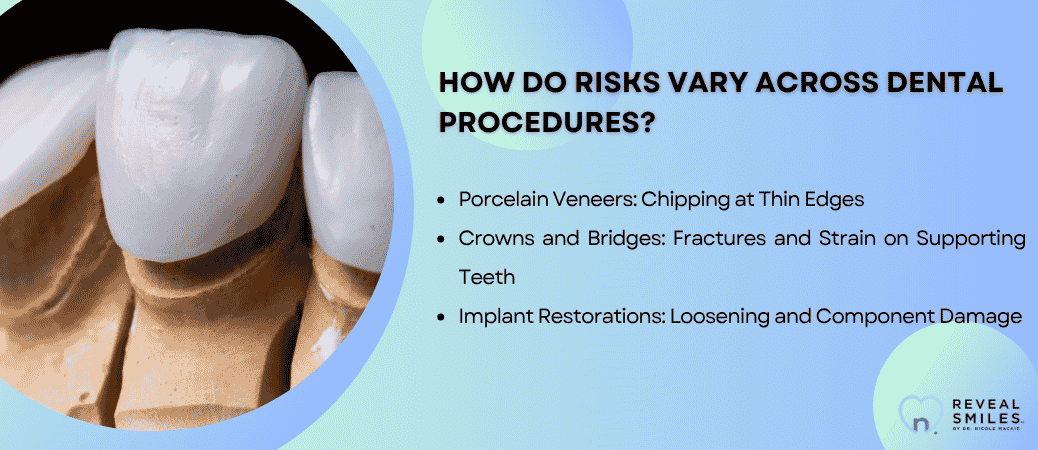
Porcelain Veneers: Chipping at Thin Edges
Veneers are thin shells bonded to the front of your teeth. Their biting edges are the thinnest part, and front teeth take force at an angle when you bite into food.
Veneer chips can develop along the front biting edge, especially after biting hard objects or years of grinding.
If your front teeth already look short or flat, that wear pattern tells your dentist your bite has been leaning on them. Planning veneers around that force helps the new edges last.
Tips that protect your veneers:
- Avoid biting ice, pens, or fingernails.
- Cut hard foods like apples into pieces.
- Wear a nightguard if you grind.
Crowns and Bridges: Fractures and Strain on Supporting Teeth
Ceramic crowns cover the whole tooth, so they handle chewing force better than veneers. Back teeth still push hard, and a single high contact point concentrates stress in one small spot.
Bridges, also called fixed dentures, span a gap. The teeth on each end carry the load for the missing tooth too. That extra work strains those anchor teeth and their gums and bone, especially if you clench.
Common signs of trouble with crowns and other prosthetic restorations:
- A crack line or chipped porcelain
- Pain when biting on one spot
- A bridge that feels slightly loose
- Sensitivity at an anchor tooth
Implant Restorations: Loosening and Component Damage
Dental implants attach straight to bone. Natural teeth sit in a cushioning ligament that gives a little and sends “too hard” signals to your brain.
Implants lack that cushion, so force passes more directly into the parts and the bone.
With implant-supported restorations, too much force tends to show up as a loose screw, a cracked crown, or a broken part.
The risk can also vary depending on the different types of dental implants and the restorations they support.
Angled forces add more stress than straight-down ones. Implant-supported prostheses that replace several teeth need even contacts so one implant does not carry most of the load.
How Do Dentists Assess Forces Before Treatment?
Dentists typically assess your bite by checking where your teeth meet, reviewing wear patterns, and evaluating your chewing and grinding habits.
Specialized instruments may also be used to measure bite force when appropriate.
Measuring Maximum Bite Force and Checking Contact Points
Maximum bite force (MBF) is the hardest you can bite at peak effort. It is measured in newtons with a small sensor you bite on for a few seconds.
In the Swedish study, patients bit as hard as possible on a strain gauge sensor in the premolar area for 2 to 5 seconds. They repeated this three times with a 30-second rest, and the readings were averaged.
This standardized method helped researchers compare maximum bite force across patients.
Strength is only half the picture. Your dentist also checks occlusal contacts, the spots where teeth meet. Marking paper or digital mapping shows which teeth hit first and hardest.
A high spot on a new crown can matter more than a high total bite force.
Keep one point in mind: MBF alone does not predict failure. The same Swedish paper notes an earlier finding of no clear link between bite force and fractures of implant-supported bridges.
Your dentist combines MBF with contact patterns, wear signs, and your habits.
Accounting for Missing Teeth, Dentures, and Implant Support
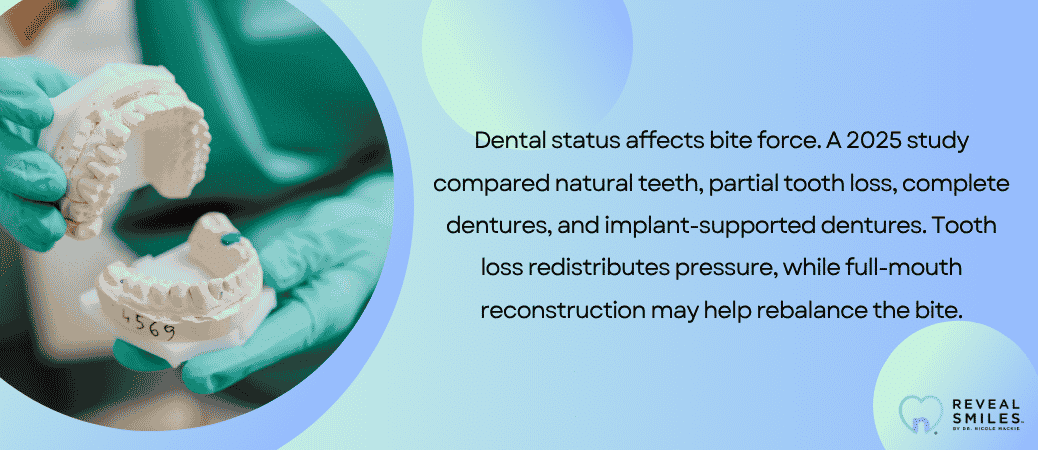
Your dental status (how many natural teeth you have and what replaces the rest) changes your bite.
A peer-reviewed 2025 study of bite force across dental and prosthetic groups compared fully dentate people, partially dentate people, denture wearers, and people with implant-supported dentures.
It measured occlusal force with the GM10 occlusal force meter and compared prosthetic treatment groups using ANOVA.
Because it was a cross-sectional study, it shows a snapshot of groups at one time. It cannot prove that one treatment causes a certain bite force. Group averages also are not a safe limit for you as an individual.
Even so, the pattern helps planning:
- Fully dentate: natural teeth and strong masticatory muscle function
- Partially dentate: force shifts to remaining teeth and partial dentures
- Edentulism with complete dentures: removable dentures rest on gums and limit force
- Implant-supported dentures: interforaminal implants in the lower jaw add firm support
Tooth loss over time also moves extra force onto the teeth you keep. If you have lost several teeth, full mouth reconstruction may rebalance the whole bite at once.
How Can Treatment Planning Help Dental Work Last?
Good planning matches the restoration to your bite, fine-tunes contacts after placement, and keeps watch for changes. Those steps protect chewing function and help your work last.
Choosing a Restoration That Fits the Bite
Your dentist weighs the tooth’s location, how much natural tooth remains, your bite strength, and whether you grind. Back teeth facing heavy chewing may call for a stronger ceramic or a thicker design.
Front teeth with heavy wear may need the bite corrected before veneers go on.
Sometimes the best choice is to fix the bite first. Orthodontic care or rebuilding worn back teeth takes pressure off front teeth so cosmetic work is not fighting the bite.
Ask your dentist why a material was chosen for your mouth.
Adjusting Contacts and Protecting Work After Placement
Occlusal adjustment means polishing tiny high spots so force spreads evenly. Right after a crown or veneer goes on, even a hair-thin high spot can feel like you are biting on a seed.
Tell your dentist right away, because that spot takes extra force with every bite.
If you grind, an occlusal splint or nightguard spreads force across a smooth plastic surface while you sleep. It takes the hit so your porcelain does not.
Custom nightguards fit better and stay in place longer than store-bought trays. Our teeth grinding page covers guard options.
Monitoring Changes During Follow-Up Visits
Your bite shifts slowly as teeth wear, gums change, or teeth drift. A restoration that fit perfectly five years ago may now hit early. Regular checkups catch these changes before a chip turns into a fracture.
At each visit, your dentist can:
- Recheck contact points on crowns and implants
- Look for small chips or wear facets
- Check implant screws and parts
- Inspect your nightguard for wear holes
Good masticatory performance and chewing efficiency are signs your prosthetic rehabilitation is working well for your oral function.
A Balanced Bite Protects Your Dental Investment
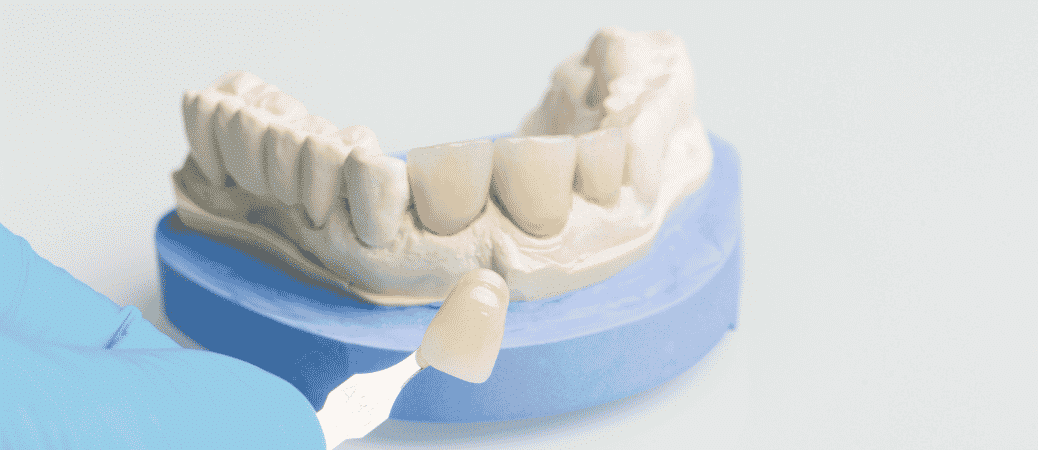
Your veneers, crowns, bridges, and implants last longest when bite force spreads evenly and stays within what the material can handle. Strong bites are common and manageable.
Problems come from force landing on thin edges, single high spots, or nightly grinding.
You now know the warning signs: small chips, a tooth that hits first, morning jaw soreness, or a loose-feeling crown. Bring these up early.
A bite check, a quick adjustment, or a nightguard costs far less than replacing a broken restoration.
Ask your dentist to evaluate your bite and review contact points before treatment, then keep up with follow-up visits so small changes can be addressed early.
Frequently Asked Questions
Can biting too hard chip porcelain veneers?
Yes, hard biting can chip veneers, mostly at their thin front edges. Biting ice, hard candy, or objects like pens concentrates force on a small area. Cutting hard foods and wearing a nightguard if you grind lowers the risk.
Can grinding or clenching loosen an implant crown?
Yes, grinding and clenching are linked to more technical problems with implant restorations, including loose screws and broken parts.
Implants lack the cushion natural teeth have, so heavy sideways force reaches the parts directly. Tell your dentist if your implant crown feels loose or clicks.
Will a nightguard protect my crowns and veneers?
A custom nightguard protects your crowns and veneers from nighttime grinding by spreading force over a smooth surface. It does not stop the habit itself, but it takes the wear in place of your porcelain.
Bring it to checkups so your dentist can check the fit.
Can a bite adjustment help prevent a dental bridge from breaking?
Yes, adjusting high spots helps spread force evenly across the bridge and its anchor teeth. This reduces stress at the spots where bridges tend to crack. Your dentist may recheck the bite over time as your teeth shift.
Does biting harder make restored teeth stronger?
No, biting harder does not strengthen restored teeth; it only adds stress to the restoration and the tooth under it. Normal chewing is all your dental work needs.
If you have questions about your bite, the team at Reveal Smiles can check your contact points and recommend protection that fits your habits.