
When you delay full mouth reconstruction, small dental problems rarely stay small. Teeth can shift, cracks can grow, and gum disease can worsen while you wait.
What may feel manageable now can slowly limit how well you chew, speak, and smile.
If you put off full mouth reconstruction, you increase your risk of tooth loss, bone damage, ongoing pain, and more complex treatment later.
Dentists often stress timing because untreated damage tends to spread. The longer you wait, the more likely you will need added procedures like extractions, bone grafts, or implants.
You also risk changes to your bite and even your facial shape if teeth remain missing for too long. Waiting can narrow your options and raise the cost and length of care.
Understanding what happens over time helps you decide when to take action.
Key Takeaways
- Delaying treatment can worsen tooth damage, gum disease, and bite problems.
- Waiting often leads to more complex and costly procedures.
- Early care helps protect your oral health and daily comfort.
Table of Content
- How Delaying Full Mouth Reconstruction Impacts Oral Health
- Long-Term Effects of Postponing Treatment
- Complications That May Arise from Delaying Dental Reconstruction
- Procedures Commonly Required After Significant Delay
- Potential Impact on Overall Health and Quality of Life
- Timely Intervention: Why Early Action Matters
- Frequently Asked Questions
How Delaying Full Mouth Reconstruction Impacts Oral Health
When you put off full mouth reconstruction, small dental problems often turn into larger ones. Tooth decay spreads, gum disease worsens, bone shrinks, and your ability to chew and speak can slowly decline.
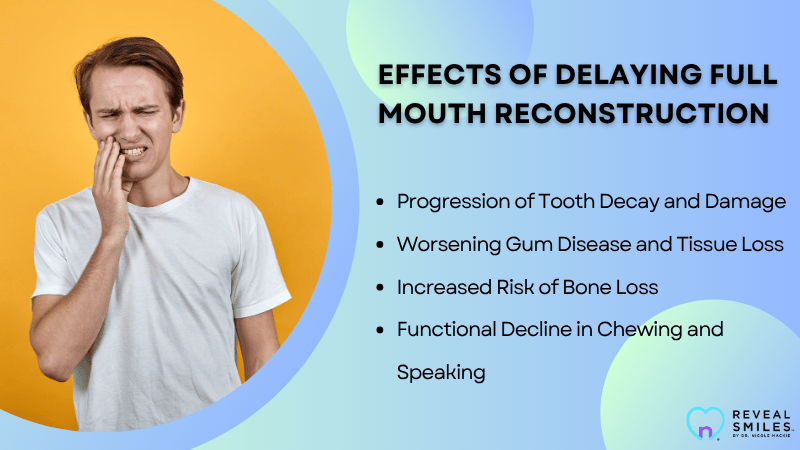
Progression of Tooth Decay and Damage
When you delay treatment, tooth decay does not stay the same. Cavities grow deeper and can reach the inner pulp of your tooth. At that point, you may need root canal therapy or even extraction instead of a simple filling or crown.
Cracked or worn teeth also weaken over time. Everyday pressure from chewing can cause small cracks to spread. What once required a crown may later require removal and replacement.
If you already have several damaged teeth, they can place extra stress on the healthy ones. This uneven pressure often leads to more fractures and wear. Full mouth reconstruction aims to restore balance, but delay allows damage to build.
Dentists often recommend reconstruction when damage affects function and comfort.
Worsening Gum Disease and Tissue Loss
Untreated gum disease can move from mild inflammation to serious infection. In early stages, you may notice bleeding when you brush. Over time, gums can pull away from your teeth and form pockets that trap bacteria.
These pockets make it harder to clean your teeth at home. Bacteria then damage the tissue and the bone that support your teeth. This process directly harms your oral health.
As gum disease advances, teeth may loosen. You might feel shifting when you chew or notice gaps forming. Delaying full mouth reconstruction in this stage can mean you need more complex treatments later, such as deep cleanings, gum surgery, or extractions.
Early care supports better oral health and protects the structures that hold your teeth in place.
Increased Risk of Bone Loss
Your jawbone depends on regular pressure from healthy teeth to stay strong. When teeth are missing or severely damaged, the bone in that area can shrink. This process is called bone loss.
Bone loss often begins quietly. You may not see changes at first, but the shape of your face can slowly shift. Sunken cheeks or a thinner jawline can develop as the bone decreases.
If you wait too long, you may need bone grafting before you can receive dental implants. That adds time, cost, and healing to your treatment plan.
Full mouth reconstruction often includes options like implants that help maintain bone by restoring pressure during chewing. Acting sooner can limit how much bone you lose and make your treatment more straightforward.
Functional Decline in Chewing and Speaking
When several teeth are missing or damaged, your chewing function suffers. You may chew on one side to avoid pain. This habit strains certain teeth and jaw muscles.
Reduced chewing efficiency can also affect digestion. Larger pieces of food enter your stomach, which may lead to discomfort. You might start avoiding certain foods, such as raw vegetables or meats, because they feel too hard to manage.
Speech can change as well. Missing front teeth or shifting teeth can alter how you form certain sounds. Words may feel harder to pronounce clearly.
Full mouth reconstruction focuses on restoring structure and balance. By correcting bite issues and replacing damaged teeth, you improve chewing efficiency and help your speech return to a more natural pattern.
Visit our office in Las Vegas, NV to restore your smile before damage becomes more complex.
Long-Term Effects of Postponing Treatment
When you delay full mouth reconstruction, your teeth, jaw, and facial structure continue to change. These changes can lead to tooth loss, bite misalignment, jaw pain, and visible shifts in your smile aesthetics.
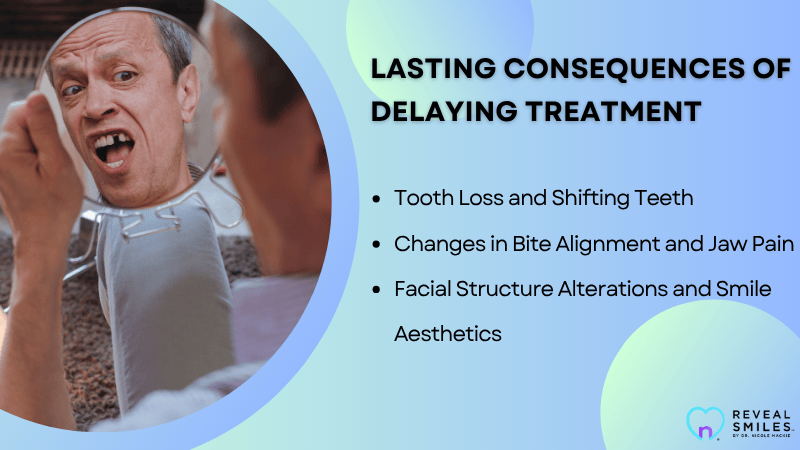
Tooth Loss and Shifting Teeth
When you live with missing teeth, the surrounding teeth do not stay still. They begin to drift into the open space. This movement can start within months and slowly worsen over time.
As teeth shift, you may notice new gaps or crowding. Food gets trapped more easily, which raises your risk of decay and gum disease. Untreated gum problems can lead to more tooth loss.
Jawbone loss also becomes a concern. Bone loss can begin within six months after an extraction. When bone shrinks, future treatment often becomes more complex and may require grafting.
If you delay too long, you may become partially or fully edentulous. At that stage, restoring your smile often takes more time, planning, and cost than if you had acted earlier.
Changes in Bite Alignment and Jaw Pain
Your bite depends on balance. When teeth are missing or damaged, that balance shifts.
Teeth move into open spaces and create bite misalignment. This can change how your upper and lower teeth meet. Even a small shift can cause uneven pressure during chewing.
You may start to feel jaw pain, headaches, or tightness near your ears. Bite issues can also strain the temporomandibular joints (TMJ). Over time, this strain may limit how wide you can open your mouth.
The longer you wait, the more your bite adapts in unhealthy ways. In some cases, you may need orthodontic treatment or more advanced procedures before you can fully restore your smile.
Facial Structure Alterations and Smile Aesthetics
Your teeth support the shape of your lower face. When you lose several teeth, your jawbone no longer receives normal stimulation.
Bone loss can cause your cheeks to look sunken. Your lips may lose support, and fine lines around your mouth can appear deeper. These changes affect your smile aesthetics and overall facial balance.
The long-term benefits of dental implants include preserving bone and maintaining facial structure. When you delay treatment, you lose that protective effect.
Over time, these structural changes make it harder to achieve natural-looking results. Acting sooner gives you more options and helps you protect both function and appearance.
Book your full mouth reconstruction evaluation today and protect your long-term oral health.
Complications That May Arise from Delaying Dental Reconstruction
When you delay dental reconstruction, small problems often grow into serious ones. You may face gum damage, bone loss, failed restorations, and the need for more complex oral surgery than you first expected.
Advanced Gum Disease and Periodontal Problems
When you postpone full mouth restoration, plaque and bacteria continue to build up around damaged teeth and gums. Over time, this can lead to advanced gum disease, also called periodontitis.
Gum tissue pulls away from your teeth. Deep pockets form and trap more bacteria. You may notice bleeding, bad breath, loose teeth, or gum recession.
As bone loss increases, your teeth lose support. At this stage, a general dentist may refer you to a periodontist for specialized care. Treatment can include deep cleanings, antibiotics, or even gum surgery.
Dental problems rarely improve on their own. The risks of delaying oral surgery include worsening decay, infection, and bone loss. Advanced gum disease can limit your options and make your dental reconstruction more complicated.
Increased Need for Extensive or Complex Procedures
Delaying treatment often turns a manageable plan into a more involved one. What could have been a simple crown or bridge may now require extractions, bone grafts, or staged oral surgery.
As damage spreads, your dentist may need to rebuild lost bone through bone grafting before placing implants. This adds healing time and cost. It also extends your overall treatment timeline.
Dental changes happen slowly but steadily. According to what happens if you delay dental treatment, problems often progress without clear warning signs. By the time you feel pain, your choices may be more limited.
A delayed case may require a more detailed comprehensive treatment plan. Your full mouth restoration could involve multiple specialists, longer recovery periods, and more appointments than originally planned.
Potential Implant Failure and Restorative Challenges
If you wait too long to replace missing or failing teeth, your jawbone can shrink. Bone loss reduces the support needed for dental implants and raises the risk of implant failure.
Without enough bone, your dentist may need bone grafts before placing implants. Even then, healing may take longer, and success rates can drop if gum disease is active.
Patients who delay replacing missing teeth often face shifting teeth and bite changes. The risks of delaying tooth replacement include further bone loss and added restorative challenges.
When your bite collapses or teeth move out of position, your dental reconstruction becomes more complex. You may need additional procedures to stabilize your jaw and create a healthy base for long-term results.
Procedures Commonly Required After Significant Delay
When you wait too long to rebuild your smile, the damage often spreads beyond one or two teeth. You may need more complex treatments that restore missing teeth, repair worn surfaces, and correct bite problems at the same time.
Dental Implants and Implant-Supported Dentures
If you lose several teeth after delaying care, you may need dental implants to replace the roots. Implants sit in your jawbone and support crowns or bridges. They help prevent bone loss, which often worsens when teeth stay missing for a long time.
In severe cases, you might need full-mouth dental implants. This option replaces all teeth in the upper jaw, lower jaw, or both. Your dentist may also suggest bone grafting if your jaw has thinned.
For wider tooth loss, implant-supported dentures offer more stability than traditional dentures. They snap or attach to implants, so they do not slide when you eat or speak. Many patients choose this option when standard dentures feel loose or uncomfortable.
These treatments often involve oral surgery and healing time. You may work with a general dentist and a prosthodontics specialist to plan each step.
Full and Partial Dentures
When many teeth are damaged or missing, dentures may become necessary. If you delay treatment and teeth cannot be saved, your dentist may remove them and fit a full denture.
A full denture replaces all teeth in one arch. A partial denture fills gaps when you still have some healthy natural teeth. Partials often use clasps or precision attachments to stay in place.
You may notice changes in your facial shape if you have lived with missing teeth for years. Dentures help support your lips and cheeks, which can improve your appearance and speech.
However, traditional dentures rest on the gums. Over time, your jawbone can shrink, which may require adjustments or relines. This is why some patients later move to implant-supported options for better long-term support.
Bridges and Crowns
If you delay care for cracked or decayed teeth, damage can spread. You may need crowns to cover and protect weakened teeth. A crown restores shape, strength, and function.
When one or more teeth are missing in a row, dental bridges can close the gap. A bridge anchors to nearby teeth or implants and supports an artificial tooth in between.
Dentists often use crowns on the supporting teeth to hold the bridge in place. This approach falls under restorative care and prosthodontics, especially when multiple teeth need rebuilding.
If wear is mild and mostly cosmetic, veneers may improve the front teeth. But when you delay too long and structure is lost, veneers are usually not enough. Crowns provide stronger coverage in those cases.
Orthodontic Solutions for Bite Correction
Untreated tooth loss and shifting can change your bite. You may develop jaw pain, uneven wear, or trouble chewing. In these cases, orthodontics becomes part of your reconstruction plan.
Braces or clear aligners can move teeth back into better position. Orthodontic treatment often comes before placing implants, bridges, or final crowns. This creates proper spacing and alignment.
If your bite has collapsed due to missing back teeth, your dentist may combine orthodontics with restorations. This step helps balance pressure across your teeth and protect new dental work.
Correcting your bite also reduces strain on the jaw joints. When you restore alignment along with missing teeth, your results tend to last longer and feel more natural.
Potential Impact on Overall Health and Quality of Life
When you delay full mouth reconstruction, problems rarely stay limited to your teeth. Your oral health can affect your body, your confidence, and how you move through daily life.
Increased Systemic Health Risks
Ongoing tooth decay, gum disease, and untreated infections can spread beyond your mouth. Bacteria from infected gums can enter your bloodstream and raise your risk for other health problems.
Research shows links between gum disease and conditions like heart disease, diabetes, and chronic inflammation.
When you avoid care, small issues can turn into severe infections. You may need extractions, bone grafts, or more complex procedures later. In some cases, delays can even lead to urgent surgery.
Full mouth reconstruction does more than improve smile aesthetics. It removes infection, stabilizes your bite, and supports better oral health, which helps protect your overall health.
Social and Emotional Consequences

Dental damage often affects how you see yourself. You may hide your teeth when you laugh or avoid photos because you feel unhappy with your smile.
People with severe dental issues often chew on one side, avoid certain foods, or skip social events..
Over time, this can lower your self-esteem. You might speak less in meetings or feel anxious in close conversations.
A full mouth reconstruction can restore your smile and improve smile aesthetics. While cosmetic dentistry focuses on appearance, reconstruction also rebuilds strength and function.
When you invest in a smile makeover that supports both function and better oral health, you often feel more comfortable eating, speaking, and engaging with others.
Timely Intervention: Why Early Action Matters
Acting early protects your teeth, lowers long-term costs, and keeps treatment simpler. When you address damage right away, you give your dentist more options and reduce the risk of tooth loss or infection.
Benefits of Early Full Mouth Reconstruction
When you start full mouth rehabilitation early, you stop small problems from turning into major damage. A cracked tooth can often be restored with a crown. If you wait, you may need a root canal or extraction.
Early care also protects your bite. Worn or missing teeth can shift your jaw and strain your muscles. Over time, this can lead to headaches, jaw pain, and uneven tooth wear.
Restorative dentistry works best when your dentist can save as much natural tooth structure as possible. A timely full mouth rehab may involve:
- Crowns to strengthen weak teeth
- Bridges or implants to replace missing teeth
- Onlays or fillings to repair decay
Acting sooner often means fewer procedures, shorter appointments, and more predictable results.
Developing a Customized Treatment Plan
Early action gives you time to build a customized treatment plan that fits your goals, health history, and budget. Your dentist can take detailed images, check your bite, and look at gum health before damage spreads.
A strong comprehensive treatment plan often includes:
- A full exam and digital X-rays
- A review of gum health
- Bite analysis
- A step-by-step schedule for treatment
When you delay, your plan may shift from preventive and restorative steps to more complex surgery or tooth replacement. Starting early gives you more control over timing and costs.
You also gain flexibility. Your dentist can phase treatment in stages, which helps you manage both time and finances without rushing decisions.
Maintaining Results with Proper Oral Hygiene
After full mouth reconstruction, your daily habits protect your investment. Good oral hygiene keeps restorations stable and prevents new decay around crowns, bridges, or implants.
You should brush twice a day with fluoride toothpaste and floss daily. If you have bridges or implants, your dentist may suggest special tools like floss threaders or interdental brushes.
Regular dental checkups are just as important. Professional cleanings remove plaque in areas you cannot reach at home. Exams also help your dentist spot early wear or gum changes before they threaten your full mouth rehabilitation.
When you act early and stay consistent with care, you support long-term comfort, function, and a stable bite.
Frequently Asked Questions
Delaying full mouth reconstruction can lead to tooth loss, bone shrinkage, chronic pain, and higher treatment costs. Acting early often means simpler procedures, shorter healing times, and better long‑term results.
What are the potential risks of postponing a full mouth reconstruction?
When you wait, small problems often grow into larger ones. A cracked tooth can break further, and mild decay can reach the nerve and cause infection.
You also risk bone loss in areas where teeth are missing. Over time, this bone shrinkage can limit your options for dental implants and may require bone grafting before treatment.
Chronic jaw pain and bite problems can worsen too. You may start to chew on one side, which strains your jaw joints and muscles.
Can delaying dental restoration procedures lead to more complex treatment later on?
Yes, it often does. What could have been treated with a crown may later require a root canal or even extraction.
If you lose more teeth while you wait, your dentist may need to replace several teeth instead of restoring a few. This can increase the number of procedures and the total cost.
Some cases of extensive damage require staged care over many months.
How might a delay in full mouth reconstruction affect overall oral health?
Untreated decay and gum disease can spread. Bacteria from infected teeth can affect nearby teeth and gums, leading to more tooth loss.
Gum disease can also cause bone loss that changes how your bite fits together. This shift may lead to headaches, jaw soreness, and difficulty chewing.
Some dental infections may also affect your general health. Ongoing inflammation has been linked to conditions like heart disease and diabetes.
What are common complications that might arise from not proceeding with recommended dental reconstruction?
You may notice teeth shifting into empty spaces. This movement can create gaps that trap food and make cleaning harder.
Your facial shape can change if you lose several teeth. Sunken cheeks and a collapsed bite can develop when bone and tooth support decrease.
Speech changes may also occur. Missing or worn teeth can make it harder to pronounce certain words clearly.
Is there a recommended maximum time to wait before starting a full mouth reconstruction?
There is no fixed deadline that fits everyone. The right timing depends on how fast your condition is progressing and how many teeth are involved.
If you have active infection, severe pain, or rapid bone loss, your dentist will likely recommend starting treatment soon. Waiting months or years in these cases can limit your options.
Regular exams help track changes. Your dentist can tell you when delay shifts from safe monitoring to higher risk.
Could waiting to begin full mouth reconstruction impact the outcome of the procedure?
Yes, timing can affect results. Healthy bone and gums support stronger, longer‑lasting restorations.
If you delay until significant bone loss occurs, you may need grafting before implants. This adds healing time and may affect the final stability.
Starting treatment earlier often allows for more predictable outcomes. You give your dentist better conditions to restore your bite, comfort, and function.