
If you are considering veneers for a smile makeover, you may be wondering, “How many veneers do I need to get the smile I want?”
For many people, 6 to 10 upper veneers are enough to create a balanced, natural-looking smile, but there is no one-size-fits-all number.
The right number depends on how many teeth show when you smile, the width of your smile, and the concerns you want to correct.
Someone looking to fix a few chipped or discolored front teeth may need only four veneers, while a wider smile may require eight, ten, or more for an even result.
Your dentist will evaluate your smile zone, tooth shape, bite, and cosmetic goals before recommending a treatment plan.
In this guide, you will learn what determines your ideal veneer count and why choosing the right number matters for a natural-looking smile.
You will also learn what can change your treatment plan, what materials cost, and how to care for your new smile once it is done
This will help you walk into your consultation feeling confident and ready to ask the right questions.
Key Takeaways
- Most full smile makeovers use 6 to 10 veneers, but your exact count depends on your unique smile.
- The teeth that show when you smile play a big role in deciding how many veneers you need.
- Your dentist will also look at tooth condition, bite, and your goals before finalizing your plan.
Table of Content
- The Typical Veneer Range for a Balanced Smile
- Your Smile Zone Determines Which Teeth Need Veneers
- Matching the Veneer Count to Your Cosmetic Goals
- Clinical Factors That Can Change the Treatment Plan
- Planning Materials, Costs, and Long-Term Care
- Frequently Asked Questions
The Typical Veneer Range for a Balanced Smile
Most people end up with a number somewhere between four and twelve veneers, and the right count depends on your smile width, tooth shape, and how much you want to change.
Your dentist will look at your specific mouth to land on a veneer count that looks natural on you.
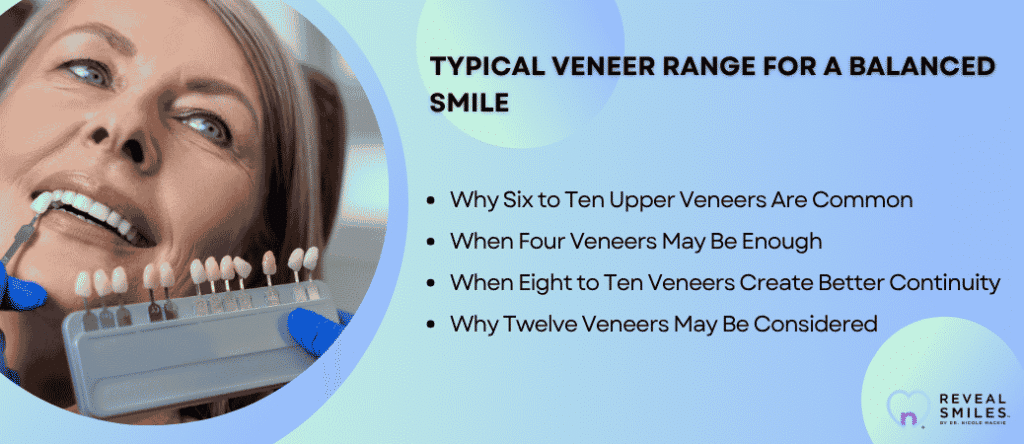
Why Six to Ten Upper Veneers Are Common
For many patients, six to ten upper veneers hit the sweet spot for a full smile makeover. This range usually covers the teeth that show when you smile normally, from the front teeth back to the premolars.
Dentists often lean toward this range because it treats your whole “smile zone” at once. That means every visible tooth gets the same shade and shape, so nothing looks mismatched.
When Four Veneers May Be Enough
You might only need four veneers if your concerns are limited to the front teeth. This is common when someone has chips, gaps, or discoloration on just their two front teeth and the two next to them.
Four veneers can work well when your other teeth already match in color and size. There’s no need to treat teeth that already look good next to your new ones.
This smaller approach often costs less and takes less time in the chair. It also means less of your natural tooth gets reshaped, since fewer teeth are involved.
If your smile issue is narrow and specific, four veneers might give you exactly what you want without extra work.
When Eight to Ten Veneers Create Better Continuity
Eight to ten veneers often create the most even, natural-looking result for a full arch change. This range covers the upper arch teeth that show during a wide smile, not just a relaxed one.
Treating this many teeth at once lets your dentist control the shade and shape across your whole smile.
That’s harder to do if some teeth are treated and others are left alone, since natural teeth can vary in color from one side of your mouth to the other.
Ten upper veneers tend to come up when your smile shows a lot of teeth, including those near the corners of your mouth.
This wider approach helps avoid an odd contrast between veneered and non-veneered teeth, which can happen if the plan stops too early.
Why Twelve Veneers May Be Considered
Twelve veneers come into play when your smile shows more of your back teeth, or when you want changes on both your upper and lower arches.
Some patients have a wider smile that reveals teeth further back than average, so stopping at ten could leave a visible gap in the treatment.
Other times, twelve veneers reflect a combined plan, such as eight on top and four on the bottom, or a full arch plus a few opposing teeth for balance.
This higher count is less common than the six-to-ten range, but it fits patients with broader smiles or more involved goals.
Your dentist will only recommend this many if your smile pattern actually calls for it.
Your Smile Zone Determines Which Teeth Need Veneers
Not every tooth in your mouth needs a veneer. Your veneer count really depends on which teeth show when you smile, laugh, or talk, and this area is called your smile zone.
Measuring Smile Width and Tooth Visibility
Your smile width plays a big role in how many veneers you need. A narrow smile might only show your front four to six teeth, while a wider smile can reveal eight to ten teeth or more.
Dentists check this by looking at photos of you smiling naturally. They also look at how your smile lines up with your facial proportions, since a wider face often means a wider smile zone.
For most people, a relaxed smile shows between 6 and 10 upper teeth.
Your natural smile isn’t always the same as your posed smile, so your dentist should watch how you smile when you’re relaxed and talking, not just when you’re posing for a photo.
How Lip Movement and the Lip Line Affect Coverage
Your lips control a lot more than you might think. Lip movement changes how much tooth structure shows throughout the day, from a small grin to a big laugh.
Your lip line, or where your upper lip sits when you smile, matters just as much. Some people have a high lip line that shows more gum tissue, which is called gum display.
Others have a lower lip line that covers more of the tooth and shows less gum.
These smile dynamics affect your treatment plan directly:
- High lip line: shows more tooth and gum, so veneers must look natural from the root up
- Medium lip line: shows the middle portion of the tooth, the most common type
- Low lip line: shows less tooth structure, so fewer veneers might be needed for a full look
When Lower Teeth Should Be Included
Most veneer plans focus on the upper arch since it’s the star of most smiles. Upper veneers cover more visible surface area for most people, which is why treatment plans often start there.
Lower veneers come into play when your lower teeth show a lot when you talk or smile widely.
If you have a flatter smile line where your upper and lower teeth show equally, skipping the lower arch can leave your smile looking uneven.
Your dentist should watch how much your lower teeth show during normal conversation, not just a big smile, to decide if lower veneers will help create a balanced and even result.
Matching the Veneer Count to Your Cosmetic Goals
The right veneer count depends on what you want to fix and how many teeth show when you smile.
Some goals need just one tooth treated, while others call for a full set to get a balanced, natural smile.
Single Veneers and Two-Veneer Corrections
A single veneer works well when you have one problem tooth. This could be a chip, a crack, or a tooth that’s darker than the rest and didn’t respond to teeth whitening.
Two veneers are common when both front teeth need matching work. This often happens with a symmetrical gap or when both central teeth show wear or discoloration.
The tricky part with a single veneer or two veneers is matching tooth color perfectly to your natural teeth.
Your dentist will look closely at shade, shape, and texture so the new tooth blends in rather than standing out.
Dental bonding is sometimes used instead for very small fixes, but veneers hold color better over time.
Four to Six Veneers for Focused Improvements
Four veneers typically cover your front teeth, the ones most people notice first in your smile. This range works well if you have chips, uneven edges, or minor color differences limited to that area.
Six veneers stretch a bit further, often including the teeth right next to your front teeth.
This gives your dentist more room to fix crooked teeth or smooth out spacing issues without touching your entire smile.
Both options are good middle-ground choices. You get a noticeable improvement without committing to a larger treatment plan.
They’re especially useful when your back teeth already look fine and don’t need any changes.
Eight to Ten Veneers for a Comprehensive Change
Eight to 10 veneers usually make up a full smile makeover. This range covers most or all of the teeth that show when you smile naturally, giving you complete control over shape, size, and tooth colour across your whole smile.
This bigger count works best if you have widespread issues like worn teeth, uneven wear from grinding, or teeth that vary a lot in shade.
It also helps with smile design changes, like adjusting how wide or narrow your smile looks.
Going with 8 to 10 veneers means every visible tooth gets treated at the same time. This creates one uniform look instead of trying to match new veneers to teeth that haven’t been touched.
Creating a Natural-Looking Transition to Untreated Teeth
Whichever number you choose, your dentist needs to blend your veneers with any natural teeth left untreated. This is especially true if you’re getting 4 or 6 veneers instead of a full set.
The color and translucency of your veneers should shift smoothly into your remaining teeth, not create a visible line where treated teeth meet untreated ones.
Your dentist may also recommend teeth whitening on your natural teeth first, so the shade matches more closely once veneers are placed.
Good planning here is what makes a smaller veneer case still look like a natural smile rather than an obvious dental treatment.
Clinical Factors That Can Change the Treatment Plan
Your dentist will look at a few key things before deciding how many veneers you need. Your tooth size, bite, gum health, and any missing teeth that can be replaced by veneers, will change the final number.
Tooth Size, Shape, and Proportion
Your natural tooth size and shape play a big role in your treatment plan. If your teeth are naturally small, short, or oddly shaped, you may need veneers on more teeth to create good tooth proportions across your smile.
Your dentist will also check your midline, which is the invisible line down the center of your two front teeth. If your midline is off, veneers can help fix that too.
Here’s what your dentist looks at:
- Tooth width to height ratio – Teeth that are too short or too wide can throw off your smile balance.
- Symmetry – Your left and right side should match in size and shape.
- Edge alignment – The biting edges of your front teeth should line up in a smooth curve.
Fixing tooth proportion issues often means treating a few extra teeth than you first expected.
Bite Alignment and Teeth Grinding
Your bite alignment matters just as much as how your teeth look. If your upper and lower teeth don’t meet correctly, veneers placed without fixing this first can chip or wear down fast.
Teeth grinding (bruxism) can damage your teeth and change your treatment plan. Your dentist may recommend a night guard to protect your new veneers from the pressure of grinding.
Skipping this step is risky. Veneers placed over an unstable bite may need to be repaired. Your dentist will likely check your bite before finalizing the number of veneers you need.
Gum Health, Gum Shape, and Existing Dental Work
Your gum health needs to be in good shape before veneers go on. If you have gum disease, your dentist will need to treat that first, since veneers placed over unhealthy gums won’t last as long.
Sometimes gum contouring is part of the plan too. This reshapes your gum line so your teeth look even and balanced once your veneers are placed.
Your dentist will also check for existing restorations like fillings and crowns.
Teeth with large fillings or old crowns may need veneers instead of just whitening, since these materials don’t respond to whitening the way natural teeth do.
This can add teeth to your treatment plan that you didn’t originally consider.
Why Missing Teeth Need Restorative Treatment First
Missing teeth change your treatment plan in a big way. Veneers only cover existing teeth, so gaps from missing teeth need to be closed with dental implants, a bridge, or orthodontic treatment first.
Your dentist may need to shift your remaining teeth back into place before adding veneers. This keeps your smile symmetrical and makes sure your bite works correctly.
Skipping this step can leave you with an uneven smile or a bite that doesn’t function well.
Getting missing teeth handled first ensures your final veneer plan looks natural and lasts as long as it should, protecting your overall oral health in the process.
If you are deciding which option fits your needs, our Veneers vs Dental Implants Guide explains the key differences between these treatments.
Planning Materials, Costs, and Long-Term Care
Once you know how many veneers you need, the next step is choosing the right material, planning your smile design, and understanding what treatment and upkeep will actually involve.
These choices affect your veneer cost, how your natural teeth are treated, and how long your new smile will last.
Porcelain Veneers Versus Composite Veneers
Porcelain veneers and composite veneers are the two main options for dental veneers, and each one works a little differently.
Porcelain veneers are made in a dental lab from thin shells of ceramic. They resist stains well and can last 10 to 15 years or longer with good care. They cost more, but they hold their color and shape better over time.
Composite veneers are made from a resin material your dentist shapes and hardens right on your tooth. They cost less and can often be done in one visit.
However, they wear down faster and may need touch-ups every few years.
Many patients use porcelain on the upper arch and composite on the lower arch to balance cost and durability.
If you are unsure what to expect from treatment, our guide on “Common Myths About Porcelain Veneers” clears up misconceptions about durability, tooth preparation, appearance, and long-term care.
Digital Smile Design and Trial Smiles

Before any work begins, your dentist will likely use digital smile design software during your smile makeover consultation.
This tool creates a computer model of your new smile based on your face, lips, and current teeth.
You get to see and approve your future smile before your dentist touches a single tooth.
This step is part of the smile analysis and smile assessment process that helps confirm the right veneer count and shape for your face.
Some dentists also offer a trial smile, sometimes called a mock-up. This is a temporary version of your veneers placed over your teeth so you can see and feel the look in person, not just on a screen.
Tooth Preparation and Veneer Placement
Tooth preparation is the step where your dentist removes a small amount of enamel from the front of each tooth. This creates room for the veneer and helps it sit flush against your natural teeth.
The amount of enamel removed depends on the type of veneer. Porcelain veneers usually need more removal than composite ones, though some porcelain options need very little prep at all.
This is also why professional treatment matters, as the risks of illegal veneers can include damage to your natural teeth, gums, and bite when treatment is performed without proper dental assessment or supervision.
Veneer placement happens after your teeth are prepped and, if needed, temporary veneers are worn while your permanent ones are made.
Your dentist will bond each veneer in place, check your bite, and make small adjustments so your teeth feel natural when you chew and speak.
How the Number of Veneers Influences Cost and Maintenance
The number of veneers you get directly affects your total cost and how much upkeep you’ll need going forward.
More veneers mean a higher upfront price, but treating a full set at once often looks more even and natural than adding veneers one at a time later.
Fewer veneers cost less at first, but you may end up paying for more work later if your natural teeth start to look mismatched next to your veneers.
No matter how many veneers you choose, good oral hygiene keeps both your veneers and natural teeth healthy. Brushing, flossing, and regular checkups protect your oral health and help your veneers last as long as possible.
If you grind your teeth at night, your dentist may recommend a night guard. This simple step protects your veneers from cracking or wearing down faster than they should.
Frequently Asked Questions
Choosing the right number of veneers comes down to your smile width, tooth visibility, and personal goals. Here are quick answers to the questions patients ask most often.
How many veneers are typically needed for a full smile makeover?
Most full smile makeovers use 8 to 10 veneers on the upper teeth. This range covers the teeth you show when you smile wide, from your front teeth back to your canines or first premolars.
Your dentist will look at your smile corridor before picking a number. This is just the group of teeth that becomes visible when you smile.
Do I need veneers on both my top and bottom teeth?
Not always. It depends on how much of your lower teeth show when you smile and talk.
If your bottom teeth barely show, upper veneers alone can give you a great result. But if your lower teeth are worn, chipped, or discolored and visible, your dentist may suggest treating both arches for a balanced look.
What is the 4-8-10 rule for veneers?
The 4-8-10 rule is a simple way to think about veneer count based on your goals.
Four veneers can fix small issues on your front teeth, eight veneers cover most of your smile corridor, and ten veneers treat the full upper arch for a complete makeover.
This rule is just a starting point. Your dentist will still check your smile in person before settling on a final number.
Is 8 veneers enough to create a natural-looking smile?
Yes, for many patients, 8 veneers can create a natural, balanced smile. This works well if you have a narrower smile that shows fewer teeth when you smile fully.
The key is making sure every visible tooth gets treated. Skipping teeth in the middle of your smile zone can leave a noticeable difference in color or shape.
How do dentists decide how many teeth should receive veneers?
Dentists look at a few things to figure out your ideal count. These include tooth size, smile width, and how much gum shows when you smile.
They also check the shape of your existing teeth and any chips, gaps, or discoloration. A wax-up model often helps confirm the plan before any real teeth are touched.
How much do 10 veneers usually cost?
Cost varies by location and the material used, but 10 upper veneers often range from $16,000 to $25,000 for porcelain. Composite veneers tend to cost less than porcelain but may not last as long.
Your final price depends on your dentist’s experience, your location, and how much prep work your teeth need. Ask for a personalized quote during your consultation.
Conclusion
Choosing the right number of veneers is about creating a smile that looks balanced while protecting the health of your natural teeth.
If you are still wondering how many veneers do I need, the answer depends on your smile width, visible teeth, existing dental concerns, and cosmetic goals.
Some people can achieve the change they want with four to six veneers, while others may benefit from eight to ten for better continuity.
Your bite, gum health, missing teeth, and existing dental work can also influence the final plan.
A personalized evaluation allows your dentist to recommend a veneer count that complements your smile and provides a natural-looking, long-lasting result.