
If you got dental implants because you were tired of dealing with cavities, you might figure your cleaning days are behind you. Titanium cannot decay, so what’s left to check, right?
That assumption is common, but dental implant hygiene remains important long after your implant has healed. The part that needs protecting is not the implant post itself. It is the living gum and bone holding it in place.
Skipping implant-specific hygiene visits does not put your titanium post at risk, it puts the gum and bone support around it at risk, which is exactly what keeps your implant stable.
Implant-specific hygiene visits check that support system in ways a standard cleaning was never designed to do.
Key Takeaways
- The gum and bone around a dental implant stay biologically active and can develop inflammation, infection, or bone loss even though the implant itself cannot decay.
- Implant hygiene visits check for bleeding, swelling, probing-depth changes, and bone levels using tools and techniques different from a standard cleaning.
- Most patients need professional implant maintenance every three to six months, though your dental team may adjust that interval based on your restoration type and risk factors.
Table of Content
- Why Implants Still Need Specialized Hygiene Care
- What Happens at an Implant Hygiene Appointment?
- How Often Should Dental Implants Be Professionally Cleaned?
- Daily Home Care for Single Implants and Full-Arch Restorations
- Consistent Maintenance Protects Your Implant Investment
- Frequently Asked Questions
Why Implants Still Need Specialized Hygiene Care
Implants need specialized hygiene care because the tissue around them behaves like the tissue around natural teeth, even though the implant itself is artificial.
The gum and bone that surround the implant, known as peri-implant tissues, stay biologically active for life. They can become inflamed, infected, or worn down by the same forces that damage natural teeth.
The Living Gum and Bone Around an Implant Are Still Vulnerable
The titanium post fuses to your jawbone through a process called osseointegration, which gives the implant its stability. That fusion does not make the surrounding gum tissue immune to problems.
Peri-implant health depends on keeping that tissue free of ongoing inflammation, the same way healthy gums protect a natural tooth root.
How Bacterial Biofilm Leads to Peri-Implant Disease
Bacterial biofilm, the sticky layer of plaque buildup that forms on any tooth or implant surface, is the main driver of trouble.
Left alone, it hardens into tartar buildup and irritates the gum, leading to peri-implant mucositis, an early and reversible form of gum inflammation.
Without treatment, this can progress to peri-implantitis, a more serious peri-implant disease that involves bone loss around the implant and threatens implant stability.
Why Implant Restorations Are Not Cleaned Like Natural Teeth
An implant crown, abutment, and the threads connecting them create tighter, less accessible spaces than a natural tooth.
Standard scalers built for enamel can scratch implant components, so your team uses instruments and techniques suited to those surfaces.
Left unaddressed, complications here can eventually lead to implant infection or implant failure.
What Happens at an Implant Hygiene Appointment?
An implant hygiene appointment checks the health of the tissue and bone around your implant, not just the surface of the restoration.
Your dental hygienist looks for early warning signs, measures changes over time, and uses tools designed specifically for implant surfaces during professional implant cleaning.
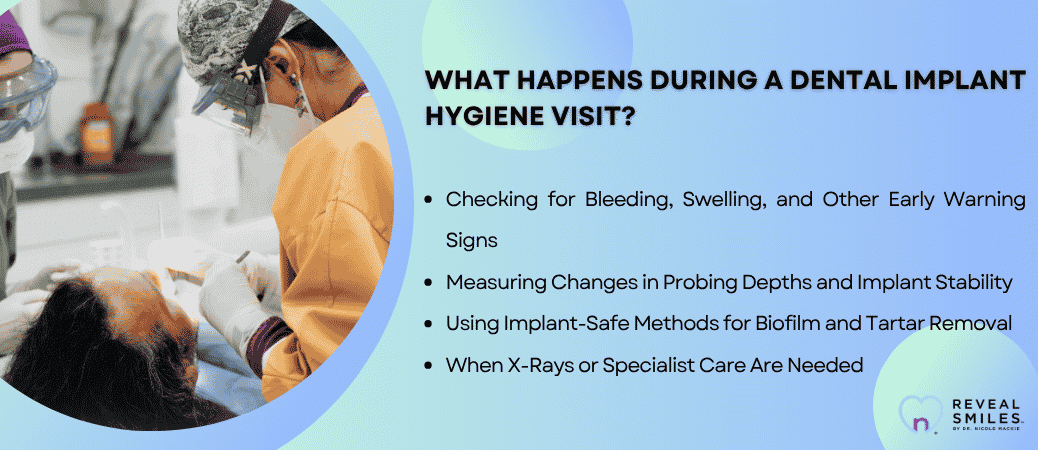
Checking for Bleeding, Swelling, and Other Early Warning Signs
Your team checks for bleeding on probing, gum swelling, and suppuration (fluid coming from the gum), all signs of gingival inflammation around the implant.
These findings help catch peri-implant mucositis before it advances, and they get recorded at every supportive implant therapy visit for comparison.
Measuring Changes in Probing Depths and Implant Stability
Probing depths, the small measurements taken around the implant with a gentle instrument, are compared against your baseline probing from earlier visits.
A deepening pocket over time can point to bone loss or weakening implant stability, even if nothing feels different to you day to day.
Using Implant-Safe Methods for Biofilm and Tartar Removal
Titanium curettes, plastic curettes, and ultrasonic devices designed for implant surfaces remove plaque index buildup without scratching the implant.
Many practices also use glycine powder air polishing, a gentle method that clears biofilm from hard-to-reach spots around the abutment and crown.
Antimicrobial treatments may be added when inflammation is present.
When X-Rays or Specialist Care Are Needed
A radiographic evaluation checks crestal bone height around the implant, and some cases call for a CBCT scan for a more detailed 3D view.
If bleeding, deepening pockets, or bone loss persist, your general dentist may refer you to a periodontist, prosthodontist, or oral surgeon, a step outlined in more detail on the failed implants page.
How Often Should Dental Implants Be Professionally Cleaned?
Most implant patients need professional cleanings every three to six months, though the right interval depends on your individual risk factors rather than a single fixed rule.
A survey of dental hygienists found maintenance intervals commonly fall in that three-to-six-month range, with higher-risk patients seen more often.
Why Many Patients Need Visits Every Three to Six Months
Shorter intervals let your dental team catch bleeding, probing-depth changes, or early bone loss around implants before they progress.
Implants do not develop cavities, but three-month checkups allow early detection and treatment before changes become permanent.
During the first year after placement, visits often happen more frequently while your provider monitors healing.
Factors That Can Shorten Your Maintenance Interval
Smoking, a history of gum disease, diabetes, full-arch restorations, and prior peri-implant disease can all justify shorter recall intervals, since these factors raise your risk for peri-implantitis.
Patients who use tobacco products may want to review the guidance in dental implants for smokers, since healing and long-term maintenance needs can differ.
Why Periodontal Monitoring Continues After Healing
Periodontal monitoring does not stop once your implant has healed.
Your bone levels and gum health can shift years later, so ongoing radiographic evaluation and probing-depth checks remain part of routine implant maintenance for as long as you have the implant.
Reveal Smiles includes long-term monitoring as part of implant care.
If gum-related concerns develop, an expert periodontist in Las Vegas can evaluate the tissues supporting your implant and recommend appropriate care.
Daily Home Care for Single Implants and Full-Arch Restorations
Daily home care keeps plaque from building up between your professional visits, and the right tools depend on your specific restoration.
A single implant crown, an implant-supported denture, and an All-on-4 full arch prosthesis each need slightly different attention.
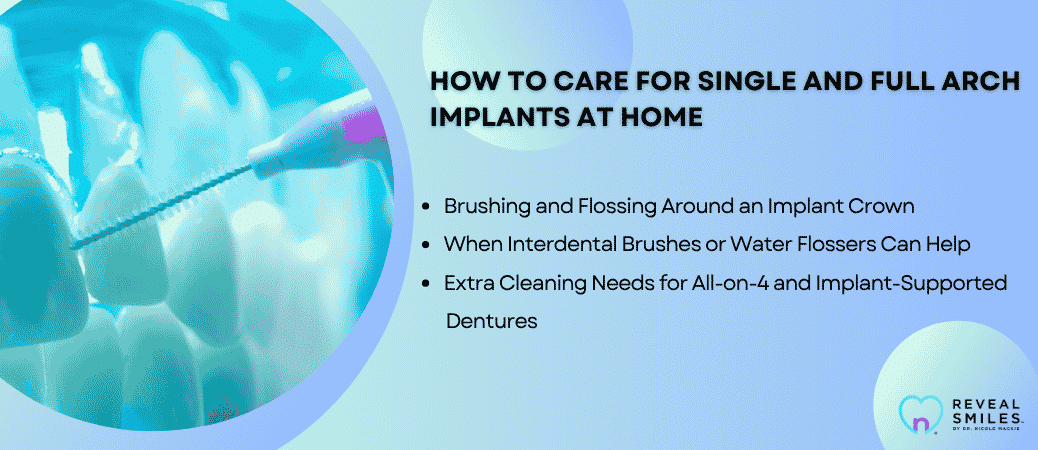
Brushing and Flossing Around an Implant Crown
Brush twice a day with a soft-bristled toothbrush, angling the bristles toward the gumline where the crown meets the gum.
Dental floss or floss designed to resist shredding around metal components helps clear plaque from the sides of the implant crown daily.
When Interdental Brushes or Water Flossers Can Help
An interdental brush, sometimes called an interproximal brush, reaches tight spots between implants and neighboring teeth that floss can miss.
A water flosser adds gentle water irrigation that can loosen biofilm around the abutment, though your dental team should confirm which tools fit your specific implant components.
Chlorhexidine rinses or fluoride products may be recommended for a period after placement or during active treatment, but not every patient needs them long term.
Extra Cleaning Needs for All-on-4 and Implant-Supported Dentures
A full arch prosthesis or denture attached to implants has more hidden surfaces where plaque collects, so interproximal cleaning under and around the bar or bridge deserves extra time each day.
Occlusal overload, uneven biting force on the restoration, can also affect implant components over time, which is one reason routine checkups matter for these larger restorations.
If you are weighing which style fits your needs, All-on-4 vs traditional dental implants breaks down the practical differences.
Consistent Maintenance Protects Your Implant Investment

Consistent dental implant maintenance is the most reliable way to protect the time and cost you put into your implants.
Routine professional implant cleaning catches inflammation and bone loss early, while your daily home care keeps plaque from building up between visits.
Skipping either half of that routine raises your risk for implant complications, including peri-implantitis and implant failure.
Staying on schedule protects peri-implant health and implant stability, supporting long-term implant survival.
Reveal Smiles designs each patient’s maintenance schedule around their specific restoration and risk factors, treating consistent care as the foundation of lasting implant success.
Frequently Asked Questions
How often do dental implants need to be professionally cleaned?
Most patients need professional implant maintenance every three to six months, though your dental team may recommend more frequent visits during your first year or if you have risk factors like smoking or a history of gum disease.
There is no single schedule that works for everyone, so this interval gets set based on your individual healing and tissue health.
Can a regular dental cleaning safely clean my implants?
A regular cleaning uses instruments and techniques built for natural tooth enamel, which is not ideal for implant surfaces.
Implant maintenance uses implant-safe tools like titanium or plastic curettes and gentle polishing methods to avoid scratching the implant components while still removing plaque and tartar buildup.
How do I clean around a dental implant at home?
Brush twice daily with a soft-bristled toothbrush and clean between the implant and nearby teeth with floss, an interdental brush, or a water flosser.
Your dental team can recommend the right combination of tools based on your specific restoration and any areas where plaque tends to build up.
What is the difference between peri-implant mucositis and peri-implantitis?
Peri-implant mucositis is early, reversible inflammation of the gum tissue around an implant, often showing up as bleeding or swelling without bone loss.
Peri-implantitis is a more advanced stage that includes bone loss around the implant and needs prompt professional treatment to protect implant stability.
What should I do if my implant crown feels loose?
A loose implant crown usually means the restoration itself has come detached from the abutment, which is different from a loose implant, where the titanium post has lost its connection to the jawbone.
Both situations need prompt evaluation, since a loose crown is often a simple fix while a loose implant may signal bone loss or infection.
Do All-on-4 dental implants need special maintenance?
All-on-4 and other full arch prosthesis designs need extra attention to the hidden surfaces under the bar or bridge where plaque tends to collect.
Your dental team may also periodically unscrew the prosthesis for a deeper cleaning and to check the fit of the restoration and underlying implant components.