
You bite down on a sandwich and notice a small click, or your implant bridge suddenly feels like it shifts when you chew.
That unexpected movement can be concerning, especially when your bridge is supposed to feel secure.
A loose implant bridge does not necessarily mean the dental implant itself has failed.
In many cases, the problem comes from a loose screw, crown, or another part of the bridge rather than the implant anchored in your jawbone.
However, movement can sometimes be related to infection, bone loss, or problems with the implant itself, which is why it should always be checked by your dentist.
Dental implants replace missing teeth by acting like artificial tooth roots set into your jawbone, so a healthy bridge should feel solid.
Until your appointment, avoid chewing on that side or trying to move the bridge yourself. Identifying the cause early can often prevent a minor issue from becoming a more complicated problem.
Waiting too long can turn a small problem into a bigger one, so here’s what the clicking might mean and what happens next.
Key Takeaways
- Stop chewing on that side, avoid home fixes, and call your dentist as soon as you notice movement.
- The loose part may be the crown, the screw, the abutment, or the implant post itself, and only an exam can tell.
- Good cleaning habits, a balanced bite, and a night guard for grinding help your bridge last.
Table of Content
- What to Do Right Away
- Identify Which Part Is Moving
- Common Reasons an Implant Bridge Clicks or Shifts
- How Your Dentist Diagnoses and Treats the Problem
- Protecting Your Bridge for the Long Term
- Frequently Asked Questions
What to Do Right Away
A loose implant bridge is usually fixable, but the first 24 to 48 hours matter.
Protecting the bridge from pressure, keeping the gums clean, and contacting your dentist early can keep a small problem from becoming more serious.
Even when an implant is affected, failed dental implants can sometimes be saved when the underlying problem is identified and treated early.
Stop Chewing on the Affected Side
Move all of your chewing to the opposite side of your mouth until you have been seen.
Every bite on a loose dental implant puts stress on the screw, the abutment, or the bone around the post.
Stick with softer foods for now. Think eggs, yogurt, pasta, soup, and cooked vegetables.
Skip these until your dentist checks things out:
- Hard foods: Nuts, ice, hard candy, crusty bread
- Sticky foods: Caramel, taffy, chewing gum
- Tough meats: Steak, jerky
If you grind or clench at night, mention it when you contact your dentist. Grinding can put extra pressure on your implant bridge.
For additional guidance, Dr. Nicole Mackie shares ways to stop clenching and grinding your teeth and manage these habits.
Keep the Area Gently Clean
Good oral hygiene matters even more when a bridge is loose. Gaps let food and plaque collect underneath, and that quickly leads to swelling and inflammation in the gum tissue.
Use a soft-bristled toothbrush and light pressure. Brush along the gumline in small circles instead of scrubbing back and forth.
A water flosser such as a Waterpik is helpful here. Set it to a low or medium pressure and aim the tip along the gumline to rinse out trapped food without tugging on the bridge.
You can also rinse with warm salt water a couple of times a day. Mix about half a teaspoon of salt into a cup of warm water and swish gently.
Avoid DIY Repairs
It is tempting to wiggle a loose bridge with your tongue or fingers, but resist. Moving it repeatedly can make the problem worse and loosen parts that were still holding.
Please do not try any of these at home:
| Don’t do this | Why it backfires |
| Tighten the screw yourself | Implant screws need a torque wrench set to an exact value |
| Use super glue or hardware-store adhesive | Not safe for your mouth and can ruin the parts |
| Use drugstore temporary cement | Can trap bacteria and hide what is really wrong |
| Pull the bridge off | May damage the abutment or gum tissue |
If a piece of the bridge or a crown falls out completely, save it in a small container and bring it to your appointment. Your dentist can often reuse it.
Know When to Seek Urgent Care
Call your dental office the same day you notice the looseness, even if nothing hurts. Many practices will fit you in quickly for a quick exam and an X-ray.
Some signs mean you should ask to be seen right away rather than waiting for the next open slot:
- Pus, a bad taste, or a bad smell around the implant
- Swelling in your gum, cheek, or face
- Throbbing pain or new sensitivity when you bite
- Bleeding gums that do not settle down
- A fever along with mouth swelling
- The implant post itself moving, not just the bridge on top
Redness and puffiness can point to peri-implantitis, a gum infection that affects the bone holding the implant.
Catching it early gives you a much better chance of keeping the implant instead of replacing it.
Identify Which Part Is Moving
A dental implant bridge is made of several parts working together, so a loose feeling can start in any one of them.
The crown or screw on top, the abutment underneath, or the implant post in your jaw can each cause movement; and each one means something different for your treatment.
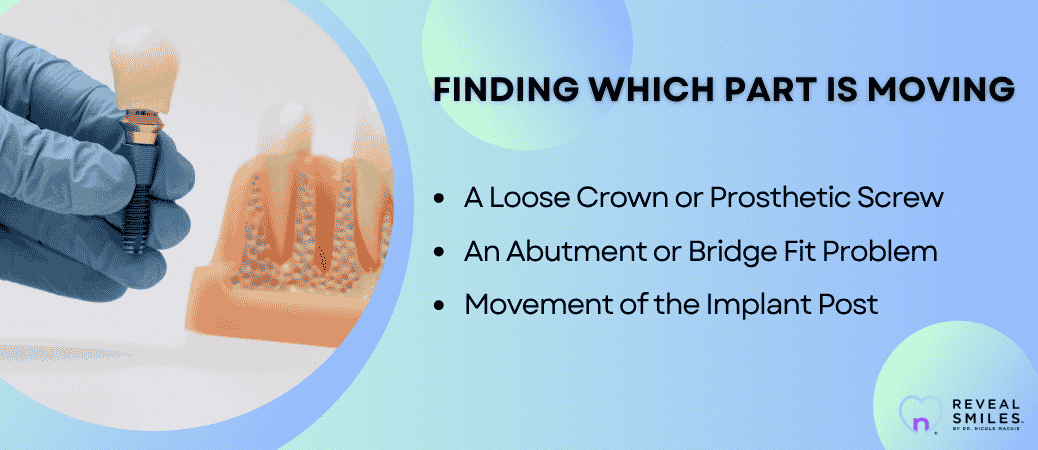
A Loose Crown or Prosthetic Screw
This is the most common reason a bridge starts to click or shift, and it’s usually the easiest to fix.
If your bridge is held on with dental cement, that cement can weaken or wash out over time.
If it’s held on with screws, one of those small screws can back out slightly after years of chewing.
Either way, the crown or bridge may rock or wobble while the post underneath stays completely solid in your bone.
Signs that point to this type of problem:
- A faint click when you bite down
- Food catching in a new spot along the gum line
- A small gap where the bridge meets your gum
- No pain, swelling, or bleeding
Your dentist can often re-cement the bridge or retighten the screw in one short visit.
If your case requires more specialized care or a second opinion, knowing how to choose an implant dentist can help you evaluate your options.
Still, don’t wait, as continued movement can wear down the screw threads or crack the porcelain.
An Abutment or Bridge Fit Problem
The abutment is the connector that sits between your implant post and the bridge. When its screw loosens, the abutment and crown tend to move together as one piece.
Sometimes the real issue is fit. A bridge that doesn’t seat perfectly puts uneven pressure on one side, which keeps working screws loose no matter how many times they’re tightened.
Grinding your teeth adds to the problem. Research links probable bruxism with higher implant failure rates, and constant clenching can bend or fracture a screw.
Your dentist will check your bite contacts here, not just the hardware. If one point on the bridge hits before your other teeth, adjusting that contact is part of the repair.
Movement of the Implant Post
This is the situation that needs faster attention. When the titanium post itself shifts in your jaw, the bone bond holding it has been lost.
Two things usually cause it. The implant may never have fully fused with the bone during healing, or gum infection and bone loss around the implant developed years later.
Watch for these along with the movement:
| What you notice | Why it matters |
| Red, puffy, or bleeding gums | Points to infection around the implant |
| Pus or a bad taste | Suggests active bone breakdown |
| Sudden increase in wiggle | The post may have lost its support |
| Soreness when chewing | Bone is being stressed, not the crown |
Here’s the important part: you can’t tell a loose implant post from a loose screw just by pressing on it with your tongue.
Your dentist needs to examine the bridge and take X-rays to determine what is actually moving and check the surrounding bone.
If you need an implant evaluation or second opinion, Reveal Smiles provides dental implant care in Las Vegas and can help determine the appropriate next step.
Common Reasons an Implant Bridge Clicks or Shifts
A clicking or shifting implant bridge usually points to one of a few problems: hardware that has worked itself loose, too much force from grinding, an infection in the gums, or bone that no longer holds the implant tightly.
Knowing which one you’re dealing with helps you understand what your dentist may need to do.
Loose or Broken Bridge Screws
This is the most common reason, and the good news is that it’s often the easiest to fix.
Your bridge is held onto the implants by small screws.
Over months and years of chewing, those screws can loosen, which lets the bridge rock slightly and make a clicking sound.
If the screw is only loose, your dentist can usually just tighten it and reseal the access hole.
A screw that has actually snapped is more complicated and may mean the bridge has to be remade.
It also helps to know which part is moving. The problem can be the crown, the abutment, or the implant itself, and each one calls for a different repair.
Teeth Grinding and Bite Pressure
Teeth grinding and clenching put far more force on your bridge than normal chewing does.
That steady pressure loosens screws, chips porcelain, and can even crack the framework.
An uneven bite adds to the problem. If one part of the bridge hits first, that spot takes the hardest hit every time you close your teeth.
Larger bridges are especially prone to wear and tear over time because the force spreads across more teeth.
Two fixes help here:
- A night guard to absorb grinding force while you sleep
- A bite adjustment so pressure is shared evenly across all the implants
Peri-Implantitis and Gum Disease
Peri-implantitis is an infection in the gum and bone around an implant. It is one of the most common complications of dental implants.
It starts with plaque buildup along the edge of the bridge, especially in spots that are hard to clean.
As the infection spreads, it destroys bone around the implant. Less bone means less grip, and the implant starts to feel slightly loose.
Watch for red or puffy gums, bleeding, bad breath, pus, or gums pulling away from the bridge. Pain isn’t always present, which is why the problem can go unnoticed.
Daily brushing and flossing under the bridge, plus regular dental checkups, catch this early. Smoking raises your risk quite a bit, since it slows healing and hurts gum health.
Bone Loss and Poor Bone Support
Your jawbone is what holds the implant steady, so bone density and bone quality matter a lot.
Bone can shrink from untreated gum disease, from an infection around the implant, or simply from years of pressure in one area.
Certain medical conditions and medications can also affect bone strength.
When bone is lost, the implant has less support. You might notice slight movement or a click when you bite down.
You may also notice that the bridge just doesn’t sit the way it used to. Even small changes in fit or pressure are worth a look, because bone loss tends to keep going without treatment.
Failed Osseointegration or Problems With Implant Placement
Osseointegration is the process where your bone grows around the implant and locks it in place. It usually takes a few months after surgery.
If bone integration never fully happens, the implant stays slightly mobile.
This is called failed osseointegration, and it’s more likely with smoking, an infection during healing, or too much pressure on the implant while it heals.
If you smoke, understanding the added considerations around dental implants for smokers can help you prepare for treatment and reduce factors that may interfere with healing.
Implant placement matters too. An implant angled poorly or placed in thin bone takes uneven force, which can lead to implant failure later on.
A truly mobile implant needs prompt attention, so don’t wait to have it checked. Treatment often means removing the implant, letting the site heal, and placing a new one.
How Your Dentist Diagnoses and Treats the Problem
Your dentist starts by figuring out which part is actually moving: the crown, the abutment, or the implant post itself.
From there, the fix can be as simple as tightening a screw, or it may involve cleaning out an infection, grafting bone, or removing the implant and starting over.
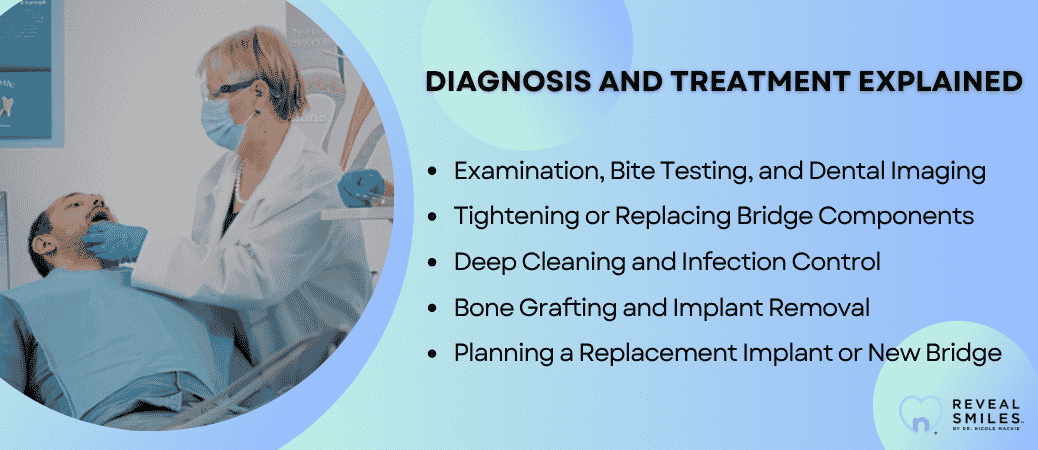
Examination, Bite Testing, and Dental Imaging
First, your dentist will wiggle each part of the bridge with an instrument to see where the movement is coming from.
This matters a lot, because a loose crown or abutment is far more common than a failing implant post.
Next comes a bite check. You’ll bite down on a thin strip of paper so your dentist can spot high spots that are taking too much force.
Then you’ll likely get an X-ray. Imaging shows bone levels around each implant, gaps under the bridge, and any cracked parts you can’t see.
Your dentist will also check for bleeding, puffy gums, or pus around the implants. Those signs point toward infection rather than a mechanical problem.
Tightening or Replacing Bridge Components
If a screw has worked its way loose, your dentist can retighten it with a torque wrench to the exact setting the manufacturer recommends. That’s often a single, quick visit.
Here’s what usually happens based on what’s loose:
| What’s loose | Typical fix |
| Abutment screw | Retightened to spec, sometimes with a new screw |
| Cemented crown | Removed, cleaned, and re-cemented |
| Cracked porcelain | Bridge repaired or remade from a new impression |
| Worn or stripped screw | Replaced with a fresh component |
Sometimes a crown has to be sectioned or drilled off to reach the abutment underneath. If your bridge needs to go to the lab, you’ll wear a temporary one for a few weeks.
Your dentist may also adjust your bite so one implant isn’t carrying more load than it should.
Deep Cleaning and Infection Control
If your gums are inflamed, the bridge usually comes off so the implant surfaces can be reached properly.
Your dentist or hygienist will use a deep cleaning to remove plaque and hardened buildup from around the implant necks.
Special tools are used here (plastic or titanium scalers, air polishing, or a laser) because metal instruments can scratch the implant surface.
You may be prescribed antibiotics or an antimicrobial rinse if there’s active infection. Chlorhexidine rinses are common for short-term use.
After that, you’ll likely be put on a tighter schedule of dental check-ups, often every three to four months, so early bone loss gets caught before it spreads.
Bone Grafting and Implant Removal
When an implant has lost too much of its surrounding bone, tightening won’t help. In that case, the implant has to come out completely.
Removal is usually simpler than the original placement, since the implant is already mobile. Your dentist numbs the area and unscrews or gently lifts it out.
If a large amount of bone is gone, you’ll need a bone graft to rebuild the implant site.
Grafting material fills the space and your own bone grows into it over roughly three to six months.
Not every case needs a graft. If the socket is clean and the bone is solid, a wider implant can sometimes be placed the same day.
Your general bone health matters too. Smoking, uncontrolled diabetes, and some medications slow healing and raise the odds of repeat implant failure.
Planning a Replacement Implant or New Bridge
Before placing a new dental implant, your dentist will look at why the first one struggled. Fixing the cause (heavy bite forces, grinding, gum disease, or poor angles) keeps history from repeating.
A CT scan helps map bone width and height so the new implant sits in a stronger spot.
Your dentist may also change the design of the bridge itself, adding an extra implant for support or splitting a long span into two shorter ones.
If you grind your teeth, a night guard is often part of the plan.
The old crown can sometimes be reused, which may help reduce your overall dental implant cost.
Expect a temporary bridge while the new implant fuses to the bone, plus regular dental checkups to monitor healing.
Protecting Your Bridge for the Long Term
Most loose or clicking bridges trace back to things you can influence: daily cleaning around the implant posts, pressure from grinding, the strength of the bone holding your implants, and how often a dentist checks the hardware.
A few steady habits keep the screws tight and the gum tissue calm.
Build an Implant-Safe Cleaning Routine
Plaque doesn’t cause cavities on titanium, but it does inflame the gum and bone around your implants. That bone loss is one reason a once-solid bridge starts to feel wobbly.
Twice a day, brush with a soft-bristled toothbrush and angle the bristles toward the gumline.
An electric brush like the Philips Sonicare DiamondClean works fine, just keep the pressure light.
The tricky part is under the bridge, where a normal string of floss can’t reach. Try these instead:
- A water flosser such as the Waterpik Aquarius on a low-to-medium setting
- Superfloss or floss with a threader, pulled side to side under the bridge
- A small interdental brush for the spaces between implant posts
Good oral hygiene habits around implant bridges also mean skipping smoking, which raises your risk of implant failure.
Use a Night Guard for Clenching or Grinding

Teeth grinding puts far more force on your bridge than chewing does, and you may not even know you’re doing it.
Over months, that pressure can loosen abutment screws, chip porcelain, or wear the biting surface flat; all things that create clicking sounds.
A custom night guard from your dentist spreads that force out instead of letting it land on one or two implants.
It fits better than a boil-and-bite mouthguard from the drugstore and lasts longer.
Signs worth mentioning at your next visit:
- Sore jaw or temples when you wake up
- Headaches in the morning
- A partner who hears grinding at night
Also stop using your teeth as tools. No tearing packages, no chewing ice or pen caps.
Support Jawbone Health Through Nutrition
Your implants stay tight because bone holds them. Feed that bone and you protect the fit.
Calcium does the structural work, and vitamin D helps your body absorb it. Aim for real food first:
| Nutrient | Easy sources |
| Calcium | Yogurt, milk, cheese, canned salmon, kale, fortified plant milks |
| Vitamin D | Salmon, eggs, fortified milk or cereal, sunlight |
| Protein | Eggs, beans, chicken, fish |
Ask your doctor before adding supplements, since needs vary by age and health.
Drinking water throughout the day also rinses food particles out from under the bridge. Go easy on very hard or sticky foods that stress the framework.
Keep Up With Ongoing Professional Care
Plan on regular dental visits every six months, or every three to four months if you’ve had gum problems before.
Your dentist or hygienist can check screw tightness, test the bite, and clean spots your brush misses.
X-rays every year or two show bone levels around each implant, which is how small changes get caught early.
Bring up any of these right away instead of waiting:
- New clicking, shifting, or movement when you chew
- Bleeding, swelling, or pus at the gumline
- Bad breath that won’t clear up
- A gap where food now packs in
A family dentistry practice that places or has records of your bridge can often retighten a screw in one short appointment.
If you notice movement or clicking, Reveal Smiles can assess your implant bridge and determine what needs to be fixed before the problem leads to a more extensive repair.
Frequently Asked Questions
A loose or clicking implant bridge usually points to a problem with the crown, the abutment, or the small screw that holds everything together; not always the implant post in your jaw.
Below are answers to the questions people ask most, including what causes sudden movement, which foods to skip, and how quickly you should call your dentist.
Why does my implant bridge feel loose when I chew?
Chewing puts pressure on your bridge from many directions. If a connecting screw has backed out slightly or the cement has washed away, you will feel that movement most when you bite down.
The crown attached to the implant is often the loosest part, and larger bridges can show wear over time.
Less often, the implant post itself is moving in the bone, which is a more serious issue.
You cannot tell the difference on your own. Your dentist needs to hold one part steady and test the others to find the real cause.
Is it normal for an implant bridge to make a clicking sound?
No. A settled implant bridge should feel quiet and solid when you eat and talk.
A faint click while chewing often means a loose abutment screw. Each time you bite, the parts shift slightly and tap back together.
Some people notice the sound before they notice any wobble. Even a painless click is worth a phone call, because instability can affect how you chew and speak and may point to something happening under the gum.
What could cause a dental implant bridge to suddenly feel unstable?
Sudden changes usually have a mechanical or biological cause. Common triggers include:
- A loosened or fractured screw from months of repeated chewing force
- Lost cement under a cemented bridge
- A cracked or chipped crown that changes how the bridge sits
- Grinding or clenching, which adds pressure your bridge was not designed for
- A blow to the mouth from a fall or sports injury
- Peri-implantitis, an infection that slowly destroys the bone holding the implant
Sometimes more than one factor is at play. Heavy bite pressure, for example, can loosen a screw and wear down the connection at the same time.
Can a loose implant bridge be tightened or repaired?
Usually, yes. If the screw is the problem, your dentist can remove the bridge, check the parts, and retighten or replace the screw.
A cemented bridge that has come loose can often be cleaned and recemented.
Damaged parts are a bigger job. A fractured screw or worn abutment may need to be removed and replaced, and a cracked bridge may need to be remade.
If bone loss or infection is behind the movement, treatment focuses on the gums and bone first before anything is reattached.
Please do not try to tighten or glue it yourself; household adhesives damage the components and make the repair harder.
Should I avoid eating certain foods if my implant bridge is clicking?
Yes, at least until you are seen by a dentist. Stick to soft foods and chew on the other side of your mouth.
Skip these until your dentist checks things out:
- Ice, hard candy, and nuts
- Caramel, taffy, and other sticky treats
- Crusty bread and tough cuts of meat
- Popcorn, especially unpopped kernels
- Raw carrots and other hard, crunchy vegetables
Also resist the urge to wiggle the bridge with your tongue or finger.
Repeated testing can wear the screw threads or damage the connection, which turns a common implant bridge problem into a costlier repair.
When should I contact my dentist about a loose or clicking implant bridge?
Call as soon as you notice movement, even if nothing hurts. Waiting gives plaque and bacteria a chance to collect around the loose parts, and delaying treatment can lead to peri-implantitis or implant failure.
Ask to be seen right away if you have any of these:
- Growing pain or swelling in the gums or face
- Pus, a bad taste, or bleeding around the implant
- A bridge that suddenly moves much more than before
- Fever or feeling generally unwell
Trouble breathing or swallowing needs emergency care, not a routine dental visit. For everything else, prompt attention to loose implants usually means a simpler, cheaper fix.